At-A-Glance Itineraries
A Classic Central Tibet Pilgrimage
Your pilgrimage begins in Chengdu or any other city in China with a flight to Lhasa. You’ll land at a comfortable elevation of just under 10,000 feet. Kongpo is celebrated for its breathtaking natural beauty, lush forests, and diverse landscapes. Thinley Norbu Rinpoche named Kongpo "Forest Valley Land," and it is often likened to the "Switzerland of Tibet" by Westerners.
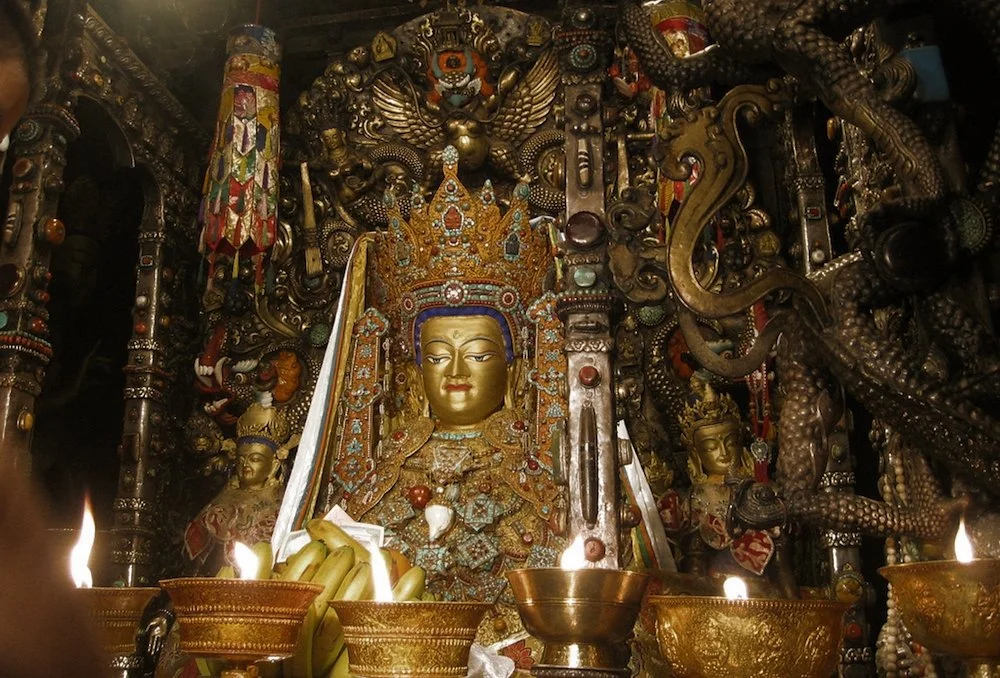
Lhasa, the Abode of the Gods . Jokhang Temple, a UNESCO World Heritage Site, Tibet’s holiest temple, features the revered Jowo Shakyamuni statue. While in Lhasa, you can explore independently and and explore the Barkhor.
Samye you can circumambulate the Samye and/or catch the sunset from Hepori Hill, a powerful geomantic site where Guru Rinpoche subdued hostile spirits. The view of Samye and the Yarlung Valley from the hilltop is stunning.
Samye is Tibet’s first Buddhist monastery, founded in the 8th century. Its architecture reflects Mahayana cosmology, with the central Temple (Utse) and surrounding structures representing Mt. Meru and the four continents. Though rebuilt several times, the complex retains its original essence. Once a major religious and political center, Samye remains a vital pilgrimage destination, with its tiered main temple, satellite temples, colorful stupas, and encircling walls creating an atmosphere of timeless devotion.
From Samye, a 35-minute drive west along the Tsangpo River leads to Tsogyal Latso, the birthplace of Khandro Yeshe Tsogyal. Located in the Drakda Valley, legendary abode of Vajra Varahi and Saraswati, her birthplace features her life-force lake or latso that emerged at her birth. Nearby, there is a spring believed to flow with her miraculous breast milk, her life-force tree, and a stupa marking her birthplace. The nuns will warmly welcome you with joy.
The next day, about an hour from Tsogyal Latso, is Drak Yangdzong where Guru Rinpoche spent three years and with Yeshe Tsogyal concealed Vajrakilaya treasure texts. A pleasant uphill trail leads to the caves, where caretaker nuns will greet you. The three most important caves, considered to be Guru Rinpoche’s Body, are accessed by a rope ladder and crawling through a short tunnel.
Behind Samye, the Chimphu Mountain Hermitage is Guru Rinpoche’s Speech. It is an active retreat area with monks, nuns, and lay persons from all over Tibet and China. Its geography has outer, inner, and secret meaning. You’ll enjoy a gentle hike and come to sites such as King Trisong Detsen’s Copper-Coloured Mountain cave hermitage, Yeshe Tsogyal’s southern cave hermitage, Jigme Lingpa’s Flower Cave, and Longchenpa’s gilded reliquary stupa. At the very top is Drakmar Keutsang where Guru Rinpoche bestowed the Eight Canons of Accomplishment empowerment to eight main disciples. There is also a stone impression where Princess Pemasel lay when Guru Rinpoche revived her.
Heading north from Samye through the Drakmar Valley, we may visit Drakmar Drinzang, birthplace of King Trisong Detsen, and then continue to Yemalung. Important highlights here are a sacred spring that emerged when Padmasambhava conferred a long-life empowerment on King Trisong Detsen, the caves of Padmasambhava and Vairotsana, and adjacent to the main temple, the Guru temple and assembly hall. The day concludes with crossing over to the south side of the Tsangpo River and reaching the small city of Tsetang.
On the final day, enjoy a restful drive through Chongye to the Valley of the Kings, where burial mounds of Imperial Kings, including Songtsen Gampo and Trisong Detsen, are located. The last pilgrimage site is Tsering Jong, where Jigme Lingpa spent his later years. This accessible temple and small nunnery, rich with relics, will provide a happy ending to your journey.
A Classic Kham Pilgrimage
Chengdu, the capital of Sichuan, is a large metropolis known for its laidback culture, teahouses, and cuisine, including zen vegetarian. You may choose to stay at the tranquil Buddha Zen Hotel for a few days to recover from international jet lag and get a taste of modern Chinese Buddhism at the nearby Wenshu Monastery with its enjoyable gardens. There’s also a nunnery nearby where you can lunch with the nuns and listen to their recitations.
Day 1 will bring you into Kham in the comfort of an SUV with your driver and guide. Your destination is about 5 hours away—Tagong, aka Lhagang, in southern Kham. The drive will offer landscapes of varying terrains and natural beauty. When you reach Tagong, you will see the iconic and eternally snow-capped Mount Yala (5,820 m). Tagong is easily walkable and offers Tibetan stone houses, a central square, and relaxing restaurants serving fresh dri yogurt and Tibetan butter tea! You’ll stay overnight in a simple hotel.
On the morning of Day 2, you will visit Tagong Monastery, built during the Qing Dynasty (1644 to 1911), to honor the journey of Princess Wencheng on her way to Lhasa for her wedding to the Tibetan King Songtsen Gampo. The temple houses the replica of the sacred statue of Jowo Sakyamuni Buddha at the Jokhang in Lhasa. Then, driving northward through vast grasslands, you will arrive at the mountainous region of Garze in a few hours. The town of Garze (aka Ganze and Kangze) radiates a strong sense of Tibetan tradition and culture andhas recently become a tourist attraction. If time allows, you can explore the markets and shops. You will be accommodated at an excellent hotel.
Now, on Day 3, in less than five hours, you will reach Palyul Monastery (3,261 m), reconstructed beginning in 1981. It is one of the Six Mother Monasteries founded in 1665. With associations with Garab Dorje and Padmasambhava, it is an important treasure site, beginning with Ratna Lingpa (1403-1471). The main practice is the Nam Cho/Sky Dharma, a revealed treasure of Mingyur Dorje (1645-1667). Drupwang Pema Norbu Rinpoche (1932-2009), a Dzogchen master, was the 11th throne holder. The temples are constructed on the mountain slopes, and there is also a retreat center. Your lodgings will be in the comfortable Palyul Monastery Hotel.
Already it’s Day 4, and you will have a short drive to Katok Dorjeden Monastery and then continue to the town of Dzongsar (3,690 ft). Katok Monastery, On Top of Ka (a hilltop resembling the Tibetan letter Ka), was prophesized by Guru Rinpoche and established in the 12th century. It is the oldest Nyingma monastery in Tibet, excluding Samye. and represents Enlightenment’s Activity. In the 16th century, it was associated with Rikzin Duddul Dorje, whose Vajrakilaya figures prominently in Dudjom Lingpa’s Vajrakilaya cycle. It is famed for its preseravation of the Canon (kama) and monastic discipline.
Today's final leg of the drive follows a narrow flowing river along winding roads until the turn-off to the small town of Dzongsar. This town is home to Dzongsar Monastery, a Sakya institution where the non-sectarian master, Jamyang Khyentse Wangpo, constructed a small temple. It was also the residence of Khyenste Chokyi Lodro. Dzongsar became one of the most vital colleges in Tibet during the 19th and 20th centuries. Today, it is the Tibet seat of the Bhutanese-born Dzongsar Khyentse Rinpoche, grandson of Dudjom Rinpoche, whom we all know. Dzongsar Monastery, majestically overlooking the valley, is not large. A short distance away by road, there is a huge new assembly hall for hundreds of resident lay practitioners. Your guesthouse in Dzongsar is in the log cabin style of Kham, well-appointed, and within walking distance to shops and restaurants.
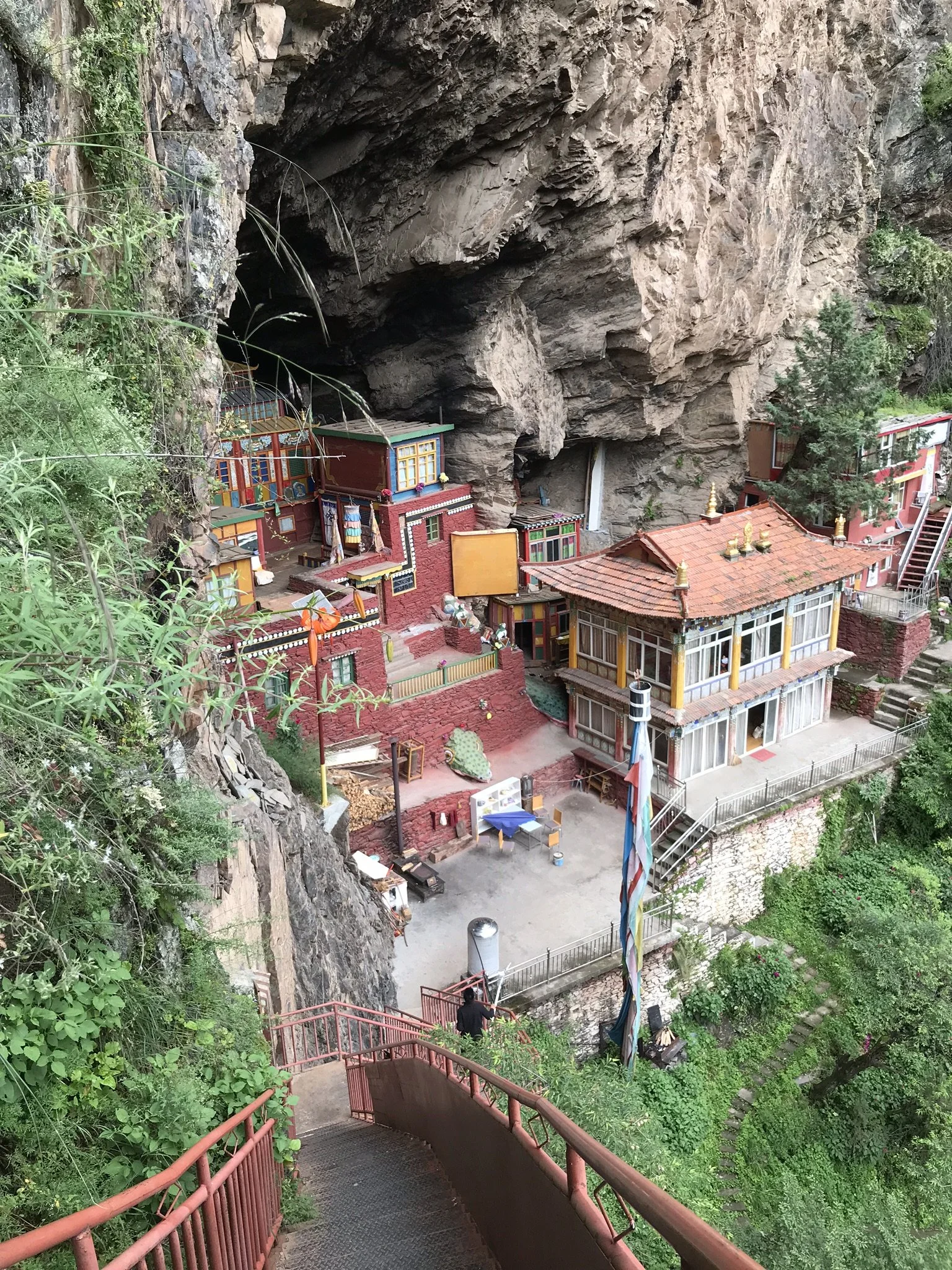
On Day 5, you will be guided along a gentle mountain path above Dzongsar Monastery for about two hours until reaching Pema Shelpuk Cave (Lotus Crystal). It is one of the twenty-five important sacred sites of Eastern Tibet and represents Enlightenment’s Qualities. It was blessed by Garab Dorje, Sri Singha, Guru Rinpoche, and Vairotsana. There is an accessible Yeshe Tsogyal cave. It is the treasure site of Chogyur Dechen Lingpa’s Three Classes of Great Perfection. Jamyang Khyentse Wangmo and Jamyang Kyentse Chokyi Lodro spent time there. There are many self-arising imprints and markings in the rock that are prophesized as future treasure portals.
Orgyen Tobgyal Rinpoche wrote: “Surrounded by white mountain cliffs, the valley of Meshö is like an open lotus flower and the foothills covered with meadows and forests. Flowers grow abundantly in summertime, and water flows here and there. In the middle, the heart of the lotus is a huge white rock with a cave in the center called Pema Shelpuk, Lotus Crystal Cave. The rock, cave, and surrounding area are all white in color. The cave contains many naturally appearing images and letters. Yeshe Tsogyal practiced in a small cave to the left, with windows that also appeared naturally, though they look man-made. The practice caves of Vairotsana and Shri Singha with their naturally-appeared thrones are at the top of the rock.”
This morning, on Day 6, you will take a short drive to the remote Rongmo Karmo Taktsang (Tiger Lair). There are thirteen Tiger Lairs in Tibet—places where Guru Rinpoche appeared as Dorje Drollo. This is one of the two that are in Tibet. This power place served as a residence for Jamgon Kongtrul Lodro Taye, Chogyur Dechen Lingpa, and Mipham Rinpoche. Tonight will be your last night at the charming Dzongsar Guesthouse.
Today, Day 7, you will behold the magnificent Dzogchen Monastery Complex. But first, you will visit the Dege Publishing House. The Dege area was consecrated by Tangtong Gyalpo, a renowned master, enginee, and artist of the 15th century. Established in 1729, until the 10th century, Dege Parkhang was the largest center publsihing house for the Kangyur, Tengyur, and texts on medicine, astrology, logic, and art. If time allows, you will visit Gonchen Monastery, rebuilt in 1987. It houses the relics of the previous Dzongsar Khyentse Rinpoche.
Dzogchen Monastery, founded in the 7th Century, and another of the Six Mother Monasteries, is the largest Nyingma monastery in Kham. Located in the valley of Rudam Kyitram with the jagged snow peaks of Mount Dorje Ziltrom, the third highest peak in Kham, in the background, and built on the side of a glacial moraine, Dzogchen represents Enlightenment’s Qualities. Legend has it that hundreds of years before it was founded, Guru Rinpoche miraculously traveled there. You will have a room in a simple hotel in nearby Dzogchen town.
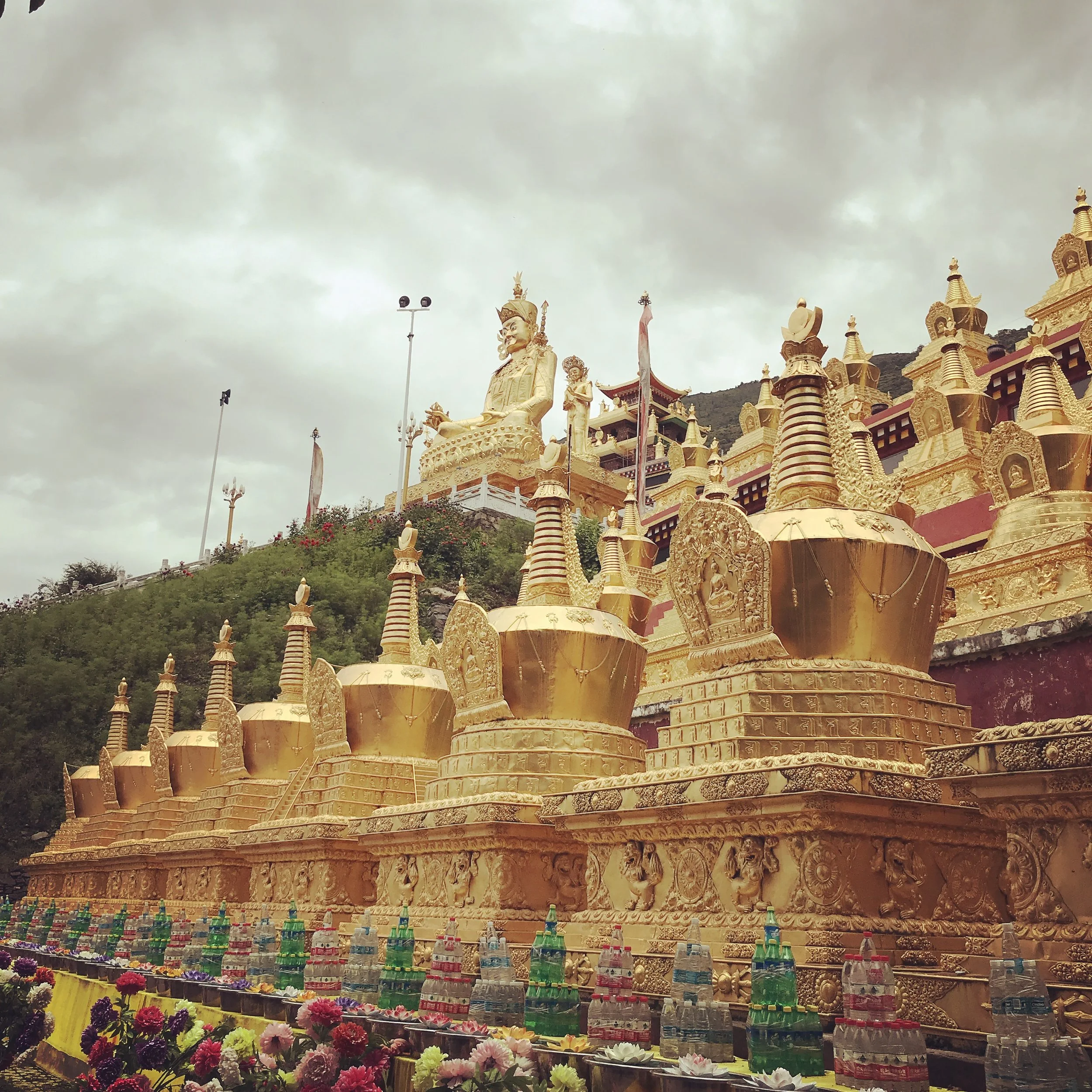
Days 8 and 9 will be spent entirely at Dzogchen, a thriving complex of magnificent temples, the Shri Singha institute, a larger-than-life standing Guru Rinpoche statue, a Dharma store managed by Chinese nuns, and hillside trails leading to hermitages, such as those of Paltrul Rinpoche, Mipham Rinpoche, and others. Did I mention lots and lots of open space and free time?
Day 10 offers a relaxing and scenic daylong drive to Yushu City, also known as Jyekundo, the center of a devastating earthquake in 2010. Everything is now rebuilt, and on the outskirts, there is a Tibetan area with temples, Mani rock walls, and Dharma teachings broadcasted on public loudspeakers. You will be accommodated at the Western Airport Aviation Hotel.
Now it’s Day 11, and you will take an afternoon direct flight to Chengdu. You may stay overnight at an airport hotel for your international flight the next day or extend your visit in China.